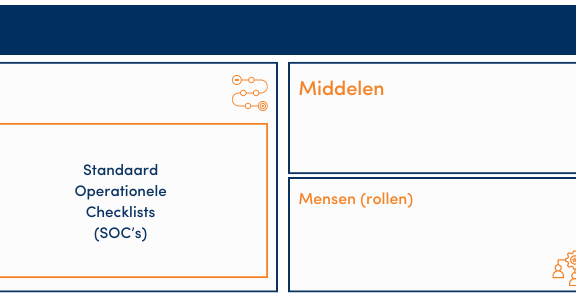
The importance of SOP's and SOC's within scalable organisations
Business systems
SOC's
SOP's
Systematic Scaling
In the current competitive landscape where margins are under pressure, scalability is an essential aspect for organisations that want to ensure their growth and success. Scalability enables companies to efficiently expand their operations without compromising on quality or productivity. To achieve this, Standard Operating Procedures (SOPs) and Standard Operating Checklists (SOCs) are crucial tools. They provide structure, consistency, and a solid foundation for growth.
Consistency and quality
One of the greatest challenges for growing organisations is maintaining consistency and quality in their products and services. As a company expands, the number of employees, customers, and processes increases, which heightens the likelihood of errors. SOPs and SOCs help overcome these challenges by offering a standardized way of working.
SOPs detail how specific tasks should be performed. They serve as a guide for employees, reducing the room for interpretation and individual input. This leads to a uniform execution of processes, which is essential for maintaining quality.
SOCs are derived from SOPs and provide a checklist of key steps in a process. They serve as a memory aid for employees, ensuring that no crucial steps are missed. This minimises the chance of errors and ensures that every task is executed accurately.
Efficiency and productivity
SOPs and SOCs increase efficiency and productivity within an organisation. By standardizing and clearly describing processes, employees know exactly what is expected of them. This reduces the need for constant supervision and guidance, allowing managers to focus on strategic decisions and growth opportunities.
Moreover, SOPs and SOCs assist in reducing the onboarding time for new employees. With access to detailed instructions and checklists, new team members can work independently more quickly and add value to the organisation. This is especially important for scalable organisations that need to respond quickly to changes in the market and demand for their products or services.
Risk management and compliance
As organisations grow, they are often faced with more complex regulatory and risk management requirements. SOPs and SOCs play a crucial role in ensuring compliance and reducing risks. By providing clear guidelines, they help ensure that all employees are aware of and comply with regulations.
In sectors where strict regulatory compliance is required, SOPs and SOCs offer an essential structure to ensure that all processes meet legal standards. This not only reduces the chance of legal issues but also protects the organisation’s reputation.
Flexibility and innovation
While SOPs and SOCs provide structure, they do not hinder flexibility and innovation within an organisation. On the contrary, by standardizing routine tasks, employees are given the freedom to focus on creative and innovative projects.
Scalable organisations can regularly evaluate and adjust their SOPs and SOCs to reflect changes in the market and technological advancements. This fosters a culture of continuous learning and improvement, allowing organisations not only to grow but also to continuously innovate and compete.
Conclusion
Standard Operating Procedures and Standard Operating Checklists are indispensable tools for organisations that aim to be scalable. They offer the structure and consistency needed to ensure quality, increase efficiency, and manage risks while providing the flexibility to innovate. For organisations that wish to maximise their growth potential, well-developed and regularly updated SOPs and SOCs are essential. They form the backbone of an efficient, responsive, and sustainable organisation.